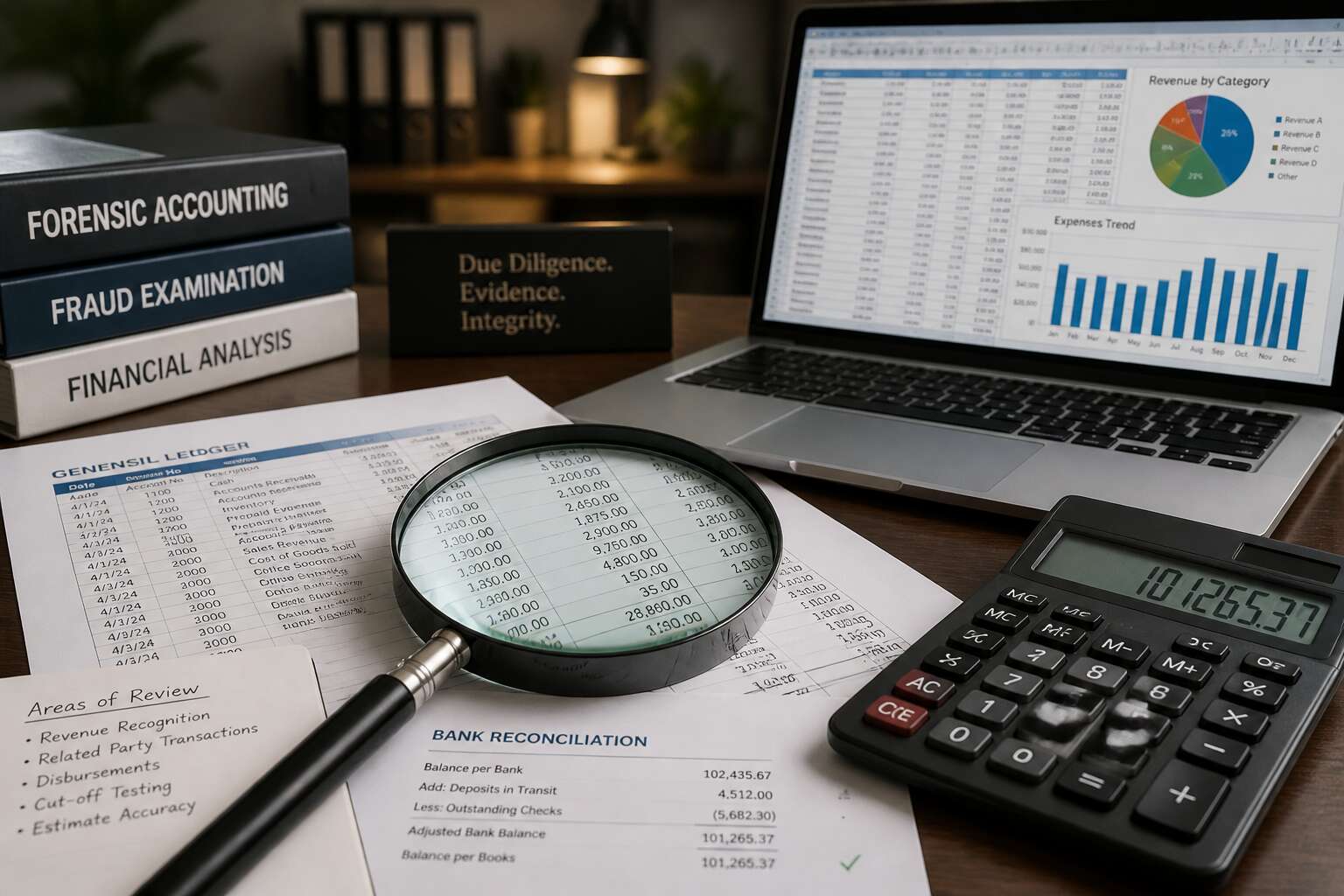
The Role of Forensic Accountants
Defining Forensic Accounting
A single forged invoice can drain a company for years. Forensic accounting blends accounting skills with legal scrutiny. This field focuses on financial evidence that courts can use. The work involves finding misstatements, hidden assets, and patterns of abuse.
In practice, a forensic accountant examines records for suspicious patterns. They recreate events from spreadsheets and bank statements. They trace deposits, withdrawals, and transfers. Their findings often decide lawsuits or criminal cases.
- Identifying hidden assets in divorce proceedings
- Uncovering corruption in public sector tenders
- Calculating damages for insurance claims
In my experience, these professionals serve as expert witnesses. Their reports must withstand cross-examination. The forensic accounting bls outlook shows a steady need for their skills. Companies and courts rely on their precision!
Key Responsibilities and Skills
Financial scandals seldom begin with a bang; they start with a number that does not add up. The forensic accounting bls outlook shows steady demand for professionals who can trace financial discrepancies. These experts do more than analyze records; they reconstruct events from ledgers, emails, and bank codes.
Their primary duties involve investigating anomalies, tracing hidden transactions, and preparing evidence for litigation. A forensic accountant also quantifies economic damages and testifies with clarity under pressure.
- Analytical thinking to detect patterns in raw data
- Attention to detail for chain of custody documentation
- Clear communication for court testimony and client updates
To excel, one needs a blend of auditing knowledge and investigative intuition. The forensic accounting bls role demands meticulous attention, yet it rewards those who can explain the numbers in plain language. With each case, the details reveal the outcome.
Industries Employing Forensic Accountants
Forensic accounting bls projections confirm that banks, insurers, and state entities in South Africa are hiring fraud specialists in record numbers. The role adapts to the industry. A commercial banker needs a forensic accountant to untangle a web of shell companies. A mining house calls one in when procurement records contradict inventory levels.
The major employers are easy to map.
- Banks and fintech firms, where transaction monitoring and anti-money laundering units operate around the clock.
- Insurance companies, where staged claims and premium fraud demand constant vigilance.
- Government departments and state-owned enterprises, where tender audits expose irregular expenditure.
- Audit firms and legal practices, where expert witnesses quantify financial losses in court.
Each industry presents a different set of controls to examine. I have seen the same document reviewed by three different specialists from three different angles. The forensic accounting bls shows no shortage of work. Patience with documents, stubbornness around missing entries, and composure under cross-examination are essential.
Forensic Accounting vs. Auditing
Auditors assess whether financial statements are materially correct. Forensic accountants determine whether a person or entity committed a wrongful act. The forensic accounting bls highlights this boundary because it changes every procedure. I have reviewed audit schedules that looked reasonable, only to find duplicate payments in the details.
- An auditor asks: is this record complete?
- A forensic accountant asks: who altered this record and why?
- An auditor issues an opinion. A forensic accountant issues a report for trial.
Both disciplines examine documents, but only forensic accounting prepares you for cross-examination.
Bureau of Labor Statistics Overview
What the BLS Does
The Bureau of Labor Statistics rarely makes headlines, but its data shapes boardroom decisions and classroom syllabi alike. For professionals tracking the forensic accounting BLS landscape, the agency offers more than employment counts. It delivers salary distributions, geographic cost adjustments, and long-term industry forecasts.
The BLS does not certify practitioners, nor does it regulate the profession. Instead, it operates as a neutral statistical bureau, collecting responses from hundreds of thousands of establishments each quarter. Its core products include:
– The Occupational Employment and Wage Statistics
– The Quarterly Census of Employment and Wages
– The Job Openings and Labor Turnover Survey
Each series serves a distinct purpose, from estimating median earnings to tracking hiring momentum. A forensic accounting BLS analyst can use these figures to identify which sectors are expanding their investigation units. The data also highlights wage premiums tied to certifications. In a field where numbers tell the story, the BLS provides the foundational context.
How BLS Occupational Data Is Compiled
A single pay period, repeated across 200,000 employers, forms the basis of the forensic accounting bls salary tables. Each spring the BLS compiles these responses into the Occupational Employment and Wage Statistics series. Employers submit headcounts and wage bands for job codes, often covering just one payroll cycle.
Statisticians then standardise titles into SOC codes and apply regional weights. A fraud examiner in Johannesburg can use these figures to gauge how a Cape Town salary compares with one in Chicago. The dataset is not a projection. It is an aggregation of what employers actually paid.
Compilation follows a fixed sequence:
- Validate outlier wages
- Adjust for part-time roles
- Apply metropolitan area weighting
The process takes months, which means the published estimates lag behind real time. That delay is the cost of reliability.
Understanding Standard Occupational Classification (SOC)
The Standard Occupational Classification, or SOC, assigns every American worker a six digit number. Forensic accountants fall under 13-2011, grouped with general auditors. The BLS treats the specialism as a variation on accounting rather than a distinct vocation, a choice that colours every salary estimate it publishes.
The hierarchy runs:
- Major group 13: Business and Financial Operations
- Minor group 13-20: Financial Specialists
- Broad occupation 13-2010: Accountants and Auditors
- Detailed occupation 13-2011: Accountants and Auditors
South Africans reading BLS tables should remember this classification is an American artefact. The figures show how US employers label staff during one pay period, not how South African firms define the role. A forensic accounting bls salary figure requires translation before it means anything in Johannesburg or Cape Town.
Limitations of BLS Data for Niche Fields
Bureau of Labor Statistics overview: the BLS measures broad employment patterns across thousands of occupations. But when you search for forensic accounting bls data, the precision evaporates. The Bureau does not recognise forensic accounting as a separate occupation. Its tables fold the specialism into the general accountant category, so published salaries reflect every accountant in the United States, not the few who investigate fraud.
The limits of this approach are plain for South African readers. A forensic accounting bls figure is an American artefact, drawn from payroll labels, not from the actual work forensic specialists perform. That alone gives a savvy reader pause!
Consider what the dataset cannot capture:
- Local salary benchmarks in Johannesburg or Cape Town
- The premium earned for expert witness work
- Demand driven by South African fraud legislation
The gap between the tables and the field is real.
Forensic Accountant Salary and Job Outlook
Median Pay According to BLS
When South African accountants look toward America for salary benchmarks, the forensic accounting bls classification reveals a small quirk. The BLS does not track forensic accountants as a separate role, so the median pay for all accountants and auditors becomes our proxy. That figure sat near $79,880 annually in 2023, a number that feels both distant and useful as a comparative anchor.
Yet the job outlook carries real weight. The BLS projects a 4% growth for this occupational group through 2032, roughly the average across all professions. For forensic specialists, though, demand runs hotter due to fraud risk, regulatory scrutiny, and the expanding digital economy.
- Holding a Certified Fraud Examiner credential often lifts salary offers.
- Sustained experience in litigation and dispute resolution commands premium pay.
- South African banks, insurers, and mining houses actively seek these exact skills.
That local appetite means the forensic accounting bls stats offer a starting point, not a ceiling, for professionals charting their earnings trajectory.
Factors Affecting Earnings
Certification is only the entry point! What truly shifts a forensic accountant’s salary is the type of work accepted. A specialist who reconstructs shredded records for a criminal trial will outearn a peer doing routine fraud checks. The employer’s scale matters too. A multinational bank sees forensic accounting bls data as a baseline, then layers on risk premiums for complex engagements. Local South African firms match those numbers once the matter involves cross-border assets.
- The stage of litigation: pre-trial investigation pays differently than expert testimony.
- Data analytics proficiency: forensic accountants who interrogate cloud ledgers earn a premium.
- The regulatory climate: new anti-money laundering rules push demand for forensic skills upward.
The forensic accounting bls outlook rarely captures these nuances. Experience in court proceedings counts, beyond mere years in the field. When a career spans both the numbers and the courtroom, the salary trajectory bends upward well beyond the national average.
Projected Employment Growth
The Bureau of Labor Statistics projects steady employment growth for accountants and auditors, roughly 4 percent over the coming decade. Forensic accounting sits inside that aggregate, never tracked as its own category. South African firms read the numbers carefully, knowing that specialised investigative roles climb faster than the published average.
Several forces feed the demand:
- Anti-money laundering compliance expanding
- Cross-border fraud investigations multiplying
- Corporate governance scrutiny tightening
Salary follows the same curve. The forensic accounting bls outlook sets a baseline. An investigator in Johannesburg who testifies in court and reconstructs digital ledgers earns beyond it. The projections understate what seasoned specialists command.
Geographic Variations in Demand
Sandton’s financial district rewards forensic accountants who untangle cross-border transactions, while Cape Town’s tech scene craves digital evidence specialists. The forensic accounting bls records national averages, but those figures flatten real regional differences. In Durban, port-related fraud investigations drive demand, whereas Pretoria’s government oversight roles attract analysts with public sector experience. Salary expectations follow the same map.
From my conversations with recruiters, several patterns emerge:
- Johannesburg pays a premium for court-ready witnesses
- Cape Town values cryptocurrency and blockchain expertise
- Durban prioritises shipping and logistics fraud knowledge
- Pretoria offers stable public sector packages
A seasoned investigator in Sandton can command far more than the national median. Those numbers from the bureau offer a baseline, yet local market intelligence matters more.
Becoming a Forensic Accountant
Education and Certification Requirements
A forensic accountant typically starts with a bachelor’s degree in accounting or finance, yet the forensic accounting bls occupational data rarely captures the specialized training these professionals pursue. Practical coursework in fraud examination, criminal procedure, and data analytics separates a general accountant from an investigator.
For South African practitioners, certification often follows a structured route:
– Certified Fraud Examiner (CFE) through the Association of Certified Fraud Examiners
– Certified Forensic Accountant (CFA) via the South African Institute of Professional Accountants
– CA(SA) registration with SAICA, which requires a completed articleship
Each designation demands a rigorous examination and documented experience. The forensic accounting bls employment figures do not distinguish these credentials, but they matter greatly for career advancement. Aspiring specialists should map their education against recognized certification paths early.
Relevant Experience and Career Paths
Financial crime in South Africa costs the economy billions annually, yet the path to investigating it remains invisible to most aspiring accountants. The leap from reconciling ledgers to interrogating suspects requires more than technical proficiency; it demands a particular temperament. You must be someone who finds comfort in ambiguity, who can sit with incomplete information until patterns emerge from the chaos.
Relevant experience typically begins in audit or internal controls, where you learn to spot anomalies within standard financial flows. But forensic specialists often tell me the real education happens in unexpected places. It happens in the police station at 11pm, waiting to give a statement. It happens in the boardroom when a CEO refuses to answer a simple question about a supplier. It happens in the forensic accounting bls reports that show employment growing in this field, even during economic downturns, because fraud does not respect business cycles.
Career paths diverge dramatically once you gain three to five years of experience. The choice depends on your appetite for risk and your tolerance for bureaucracy. Some land in the commercial crime units of major banks, while others join multidisciplinary consultancies. There are several routes worth considering:
– Investigating white collar crime within law enforcement agencies, where you work alongside detectives and prosecutors
– Advising legal teams on complex litigation matters, quantifying damages for civil proceedings
– Designing and implementing anti fraud controls for listed companies, focusing on prevention rather than detection
– Working as an expert witness, where your credibility under cross examination becomes your most valuable asset
Experienced forensic accountants develop a sixth sense for where documents hide. They know that the truth often lives in expense claims, in petty cash reconciliations, in the discrepancy between a supplier invoice and the market rate for services rendered. The work becomes less about numbers and more about human psychology. You start reading people as closely as you read financial statements.
The forensic accounting bls occupational outlook suggests steady demand, but the reality in South Africa is more nuanced. The market rewards those who can bridge the gap between financial expertise and investigative instinct. Nobody hands you this career on a platter. You build it through choosing the right mentors, volunteering for the difficult cases, and accepting that your training never really ends. Every engagement reveals a new way to hide money, and every successful investigation makes you more valuable to the next employer.
Professional Organizations and Resources
Professional bodies in South Africa function as more than credentialing machines. The Institute of Commercial Forensic Practitioners, the Association of Certified Fraud Examiners South Africa chapter, and the Forensic Accounting Professional Body maintain active communities. Membership grants access to disciplinary hearings, case studies, and informal networks where investigators trade practical knowledge.
The forensic accounting bls outlook indicates steady demand, but these organisations teach what statistics cannot. They reveal how local courts treat digital evidence, which experts carry credibility, and where current fraud patterns hide.
- The ICFP hosts annual symposia on commercial forensic practice
- ACFE South Africa offers certified fraud examiner credentials and regional chapter meetings
- SAICA maintains forensic interest groups for chartered accountants
Publications such as the Journal of Forensic & Investigative Accounting and local conference proceedings keep practitioners current. Investigators never work in isolation. The organisations hold the institutional memory of past cases, and that memory guides practitioners through ambiguous engagements. The forensic accounting bls projections confirm formal growth, but the bodies shape how careers actually develop.
Using BLS Data for Career Planning
The forensic accounting bls data does more than publish salaries. It maps the terrain of a career before you commit. When I studied the employment projections, I noticed how many industries hire these professionals beyond traditional roles. That information changed my approach to networking and skill building.
BLS numbers also reveal the cyclical nature of fraud investigations. In times of economic stress, the forensic accounting bls outlook often shifts upward. For a South African professional, understanding these patterns helps you anticipate where your expertise will be needed, even if you plan to work locally. The data quietly shapes decisions you did not know you were making.
Common Misconceptions About the Field
People assume becoming a forensic accountant requires a mathematics degree. The truth unsettles them. Most fraud examiners come from accounting backgrounds, but their real toolkit involves psychology, legal knowledge, and a stubborn curiosity. The forensic accounting bls data does not show that side of the work.
Another misconception involves the daily grind. Television suggests constant chase scenes. The reality involves thousands of spreadsheets and the patience to follow a single transaction across years. The work is meticulous, not glamorous.
- You need a CPA licence before you can start.
- Only law enforcement agencies hire forensic accountants.
- The job never involves court testimony.
None of those statements hold up. The forensic accounting bls outlook actually reveals a field where entry points vary, and private firms compete with government bodies for talent.




0 Comments